Reducing food waste in hospitality: a stock control guide
General information for UK hospitality operators, not legal advice. If something here is wrong or out of date, the editorial policy explains how to report it.
Reducing food waste starts with accurate stock counts and clear reason codes, not guesswork. Here is how UK venues cut waste and protect margin.
How much profit is disappearing through the bin without anyone noticing? For most kitchens the honest answer is more than the profit and loss account admits, and reducing food waste is one of the few cost-control jobs where the saving is close to pure margin rather than a percentage of a percentage.
Where reducing food waste starts in the kitchen
Food waste in a professional kitchen rarely comes from one dramatic mistake. It builds up from four ordinary sources: over-ordering against uncertain demand, stock that is not rotated so the older item sits behind the new one, portions that creep above the specification on the recipe card, and dishes kept on the menu long after they stopped selling well enough to justify the ingredients tied up in them. None of these show up clearly as a single line on a P&L. They show up as a gap between what the kitchen should have used, based on sales and recipe costings, and what actually left the stores. Reducing food waste means closing that gap, and closing it starts with counting stock often enough, and consistently enough, to see the gap in the first place rather than guessing at it once a month. A manager who only ever looks at the monthly gross profit figure will see that the number has slipped, but will have no way of knowing whether the cause was a supplier price rise, a portion problem, or three trays of prepped food thrown away on a quiet Tuesday. Waste reduction is, at bottom, a data problem before it is a discipline problem.
Over-ordering and inaccurate forecasting
Ordering decisions are often made against a supplier's delivery schedule rather than against actual demand, which pushes stock levels higher than the kitchen needs and leaves perishable items exposed to spoilage before they can be used. It is a common pattern for a kitchen to order the same quantity of a fresh product every week regardless of how trade actually moved the previous week, simply because that is the quantity that has always been ordered and nobody has revisited it since the menu last changed. Sales history is the more reliable guide, because it shows which dishes moved on a given day of the week and how that varies with covers, weather or a local event such as a match or a bank holiday. A kitchen that orders against that pattern, rather than against a fixed weekly quantity set months ago, tends to carry less stock at any one time and throws away less of it, because the delivery arriving on a Thursday is sized to what a Thursday actually needs rather than to a rough average across the whole week. Linking ordering decisions to real-time sales data turns forecasting from a guess into something closer to a repeating pattern, which is where much of the over-ordering waste can be removed without changing the menu at all. It also shortens the feedback loop: a forecasting error shows up within a week or two rather than being buried in a monthly average that smooths it away.
Portion drift and recipe specification
A recipe card only controls cost if it is actually followed at the pass. Portion drift, where staff serve a slightly larger scoop of chips or an extra ladle of sauce, rarely looks like a problem in the moment because each instance is small and nobody notices a few extra grams going onto a plate. Repeated across a service, a week and a full menu, it becomes one of the more expensive and least visible forms of waste, because it never shows up as spoiled stock sitting in a bin waiting to be counted. It shows up only as a gross profit percentage that quietly falls short of the figure on the costing sheet, with no obvious single cause a manager can point to. New staff are particularly prone to it, simply because they have not yet been shown, or checked against, the exact weight or scoop size the dish is supposed to use, and busy staff under pressure will often plate by eye rather than by the spec once a rush starts. Training staff to plate to the specification, checking scales and scoop sizes periodically rather than assuming a briefing given once at induction still holds months later, and spot-checking a handful of plates during a quiet service, closes a gap that stock counts alone will not reveal, because the stock has left the building correctly recorded as sold, just at a higher cost per portion than the menu was priced to allow.
Stock counts, rotation and date labelling
First in, first out sounds simple and is routinely not followed under service pressure, when the nearest box on the shelf gets used rather than the older one sitting behind it, because nobody has time mid-service to dig to the back of a chiller. Regular stock counts, done often enough to catch drift before it turns into loss, are the practical check on whether rotation discipline is holding up in practice rather than existing only as a rule printed on a wall. Counts are only as reliable as the labels on the stock being counted, which is why accurate date labelling once items are opened or decanted matters as much for cost control as it does for safety, since an unlabelled or wrongly labelled container is either thrown away on suspicion or, worse, used past the point it should have been. The Food Standards Agency's guidance on best before and use-by dates sets out the difference between the two, which is worth knowing when deciding whether an item still has commercial value or needs to be written off; a best-before item that has passed its date may still be perfectly usable, while a use-by item past its date should not be served regardless of how it looks or smells.
Turning waste into data: reason codes and GP
A bin bag tells a manager that waste happened. A reason code tells them why. Logging waste against categories such as expired, over-produced, damaged on delivery or returned by a customer turns a vague sense that too much is being thrown away into a list that can actually be acted on, because each category points toward a different fix.
| Reason code | Likely cause | Where to act |
|---|---|---|
| Expired | Over-ordering or slow rotation | Order quantities and FIFO checks |
| Over-produced | Forecasting error for the shift | Prep quantities against sales history |
| Damaged on delivery | Supplier handling or storage | Supplier checks and delivery inspection |
| Returned or sent back | Cooking, plating or order accuracy | Kitchen training and order checks |
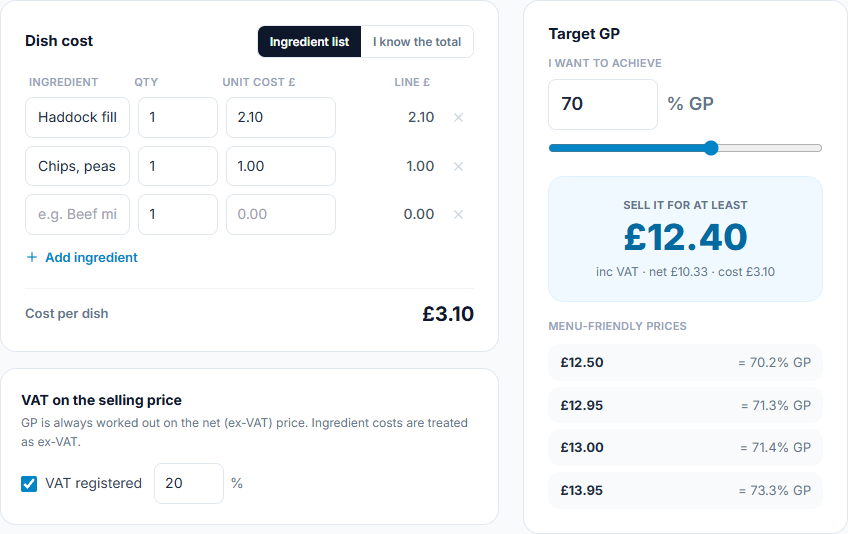
Weekly stock counts set against theoretical usage are what expose the gap between what a dish should cost and what it is actually costing, and waste logged by reason is usually the largest single piece of that gap once portion drift and pricing errors have been ruled out. Running the numbers through a GP calculator shows quickly how much a modest change in waste or portion size moves the margin on a single dish, let alone across a menu of forty items where a small saving on each one adds up. Structured stock management that records counts, wastage and supplier data in one place makes that pattern visible without a manager having to reconstruct it from memory or from a stack of paper stock sheets at the end of the month.
The legal side: waste disposal and record keeping
Reducing the volume of food waste is only part of the picture; how it is then disposed of is separately regulated. Guidance on business waste and food waste sets out what venues in England now need to do with food waste rather than sending it out with general refuse, and separating food waste correctly at the bin area is a compliance point as well as a tidiness one, since mixed waste can attract additional charges or, in the worst case, enforcement attention. Alongside that, the supplier invoices that stock counts are checked against form part of the business records that need to be retained; VAT rules require records including purchase invoices to be kept for six years, which is worth bearing in mind before delivery notes and supplier paperwork are thrown away once a bill has been paid, particularly where those documents are also the reference point for resolving a pricing or quantity dispute with a supplier months after the delivery arrived.
Where Zynthio fits
Zynthio's stock management tools keep stock counts, wastage reason codes and supplier records together in one place, so the gap between theoretical and actual usage stays visible rather than getting rediscovered at stocktake.
Frequently asked questions
How often should a kitchen count stock to control waste?
Fast-moving and high-value items are worth counting weekly so drift shows up before it becomes a real loss, with a full stocktake at least monthly across the whole store. Kitchens carrying expensive or high-risk stock, such as fresh fish or meat, often benefit from checking those lines even more frequently.
What is the difference between over-production waste and spoilage waste?
Over-production waste is food cooked or prepped that was never sold, usually because forecasting overestimated demand for a shift. Spoilage waste is stock that was bought correctly but not used before it expired, usually pointing to a rotation or ordering-quantity problem rather than a forecasting one. Logging both under separate reason codes shows which fix is needed.
Does reducing food waste actually move gross profit?
Yes, because waste is one of the few costs that sits entirely outside recorded sales; every portion thrown away was still bought and still counted against the food cost line. Cutting it does not require selling more, only using more of what has already been purchased, which is why the saving tends to land close to pure margin.
How long should supplier invoices and delivery notes be kept?
VAT rules require business records including purchase invoices to be kept for six years, so it is sensible to retain supplier delivery notes and invoices for at least that period rather than discarding them once a bill is settled, particularly where they are used to check stock counts or resolve a pricing dispute.
What is FIFO and why does it matter for waste?
FIFO, first in first out, means using older stock before newer stock of the same item. It matters because a kitchen under service pressure will otherwise reach for whatever is nearest, leaving the older item to sit until it spoils. Regular stock counts are the practical check that rotation is actually happening rather than assumed.