Probe thermometer calibration: the check every kitchen needs
General information for UK hospitality operators, not legal advice. If something here is wrong or out of date, the editorial policy explains how to report it.
Probe thermometer calibration is the check that decides whether every temperature record your kitchen keeps can be trusted by an inspector.
Probe thermometer calibration is the check that confirms a probe still reads true, run against two known reference points and written down with the reading obtained and a pass or fail result. It matters because the figures a probe produces carry legal weight: food cooked or reheated in England, Wales and Northern Ireland must reach 75°C at the core, and in Scotland reheated food must reach 82°C.
A probe is the most-used measuring instrument in a commercial kitchen, and like any instrument it drifts with knocks, heat and age. A probe that reads low gives false confidence backed by a written record, which is worse in practice than having no probe at all, because a manager will trust a wrong number as readily as a right one. Correcting that does not need laboratory equipment or an external contract. It needs a short check, repeated on an interval the kitchen actually keeps to, and recorded whether it passes or fails.
Why probe thermometer calibration protects every record you keep
A fridge log, a cook temperature and a hot-hold check are only as good as the instrument that produced them. If a probe is found to be two degrees out during a routine check, the honest response is not simply to fix the probe. It is to accept that every reading taken with it since the last known-good check is now uncertain, which is an uncomfortable position with a delivery already accepted, a batch already served, or a week of fridge logs already filed as passed. A check run on a set interval, rather than once when the probe was new and then forgotten, closes that gap before it opens.
It also changes how a manager reads a run of borderline temperatures. A fridge logging 6°C or 7°C for several days is a different problem depending on whether the probe reading it has just been confirmed accurate or has not been checked in months. In the first case the fridge is at fault. In the second, nobody can say which of the two is wrong until the probe is checked, and the fridge may be repaired at cost while the real fault stays in a drawer.
The two-point check every kitchen can run
Verifying a probe does not need specialist kit. Probe manufacturers set the method out in the instructions supplied with the instrument, and it uses two reference points any kitchen can reproduce with a jug and a kettle: an ice point of 0°C and a boiling point of 100°C at sea level. For the ice point, fill a jug with crushed ice, top it up with cold water, stir it thoroughly, then insert the probe clear of the sides and the base so it sits only in the ice and water mixture, and wait for the reading to stop moving. For the boiling point, put the same probe into clean boiling water, again clear of the pan sides.
The ice check on its own is generally enough for chilled work such as fridge checks and delivery acceptance, because that is the range those tasks operate in. A kitchen that also cooks, reheats and hot holds has reason to run both, since a probe can be accurate at one end of its range and out at the other, and a single reference point would never show it. The gov.uk guidance on checking food is thoroughly cooked says food can be checked by inserting a thermometer with a clean probe into the centre, which only means something if the thermometer doing the inserting has itself been checked.
Reading the tolerance the manufacturer sets
The pass or fail line does not come from a rule of thumb passed around a kitchen. It comes from the probe manufacturer's instructions, which state the variance the instrument is expected to hold against each reference point. A reading inside that stated variance means the probe can stay in use. A reading outside it means the probe is adjusted where the model allows adjustment, or taken out of service where it does not, because a probe with no adjustment mechanism that has drifted outside its stated tolerance cannot be trusted back into rotation however inconvenient the replacement is.
| Reference point | How the kitchen reproduces it | Where the pass or fail line comes from |
|---|---|---|
| Ice point, 0°C | Jug of crushed ice topped up with cold water, probe clear of the sides and base, reading left to settle | The variance stated in the probe manufacturer's instructions |
| Boiling point, 100°C at sea level | Clean boiling water, probe clear of the pan sides, reading left to settle | The variance stated in the probe manufacturer's instructions |
A probe that fails either check should not be quietly retired to a drawer. It should be logged as failed, dated, and either replaced or repaired before it touches food again. Writing the failed reading down alongside the passes is what makes the record credible rather than selective, and a log that only ever shows passes invites the obvious question about what happened to the failures.
What an environmental health officer expects to see
Owning a probe is not the point of an inspection. Owning evidence that it is checked and acted on is. The gov.uk food safety management system guidance tells a food business to set limits for its critical control points, monitor those points, put checks in place to make sure the system is working, and keep records of the checks and of how problems were put right. A probe with no calibration history sits awkwardly against all four, because it is the instrument doing the monitoring.
Where the system is built on Safer food, better business, the Food Standards Agency pack used in England, Wales and Northern Ireland while Scotland uses CookSafe, that same guidance says completed diary pages should be stored until the next visit from a local authority food safety officer, electronically or on paper, and that the officer may want to look at them as well as the pack itself. A calibration record belongs in that bundle. What an officer reads it for is a dated entry showing the reading obtained, whether it passed, who carried out the check, and what happened next if it failed. The same principle runs through the wider due diligence defence built from food safety records, where the strength of a defence rests on consistent dated evidence across weeks and months rather than a single good day chosen to show an inspector.
Deciding how often the check happens
There is no single interval that applies to every kitchen. How often a probe is checked is the operator's decision, made inside the HACCP-based food safety management system the business is required to run, and that system is where both the interval and the reasoning behind it belong. What makes an interval defensible is that it is written down, applied consistently, and backed by records showing it happened.
Whatever interval is set, an extra check earns its place after a specific event: a probe dropped on a tiled floor, left inside a hot oven, moved between sites, or restarted on a fresh battery. Any of those can shift a reading without changing how the probe looks. Building the check into the same routine as the temperature logs it supports, rather than leaving it as a separate job somebody has to remember, is what keeps it happening in a bad week. That is the logic behind reliable fridge and freezer temperature records across the cold chain as well: a single missed entry rarely causes a problem on its own, but a pattern of gaps is what an inspector or an insurer notices first, and it is far harder to explain after the fact than one failed calibration caught and corrected on the day. Recording the check as a task on a daily list, of the kind built into HACCP monitoring and corrective action software, keeps the calibration result in the same place as the readings it underwrites.
The habits that cause probes to drift
Most calibration failures trace back to a handful of habits rather than a faulty batch of equipment. Probes that are not cleaned and disinfected between uses, particularly between raw and ready-to-eat food, carry a contamination risk that has nothing to do with the number on the display, and no calibration check will ever catch it. Inserting the probe into the thickest part of the food and waiting for the reading to settle, rather than accepting the first figure a fast-updating screen shows, removes a common source of false passes.
A weakening battery is one of the least obvious causes of erratic readings, which is why logging battery changes next to calibration results helps explain a run of odd numbers instead of leaving it a mystery blamed on the fridge or the supplier. Keeping a spare probe on site means one failed check does not stop the rest of the day's checks, and it removes the temptation to carry on using a probe the kitchen already suspects. The same discipline is worth applying to the system the probe sits inside, as covered in building a HACCP plan an EHO will respect, where monitoring equipment is one control among several that all depend on being checked and recorded consistently.
Next step
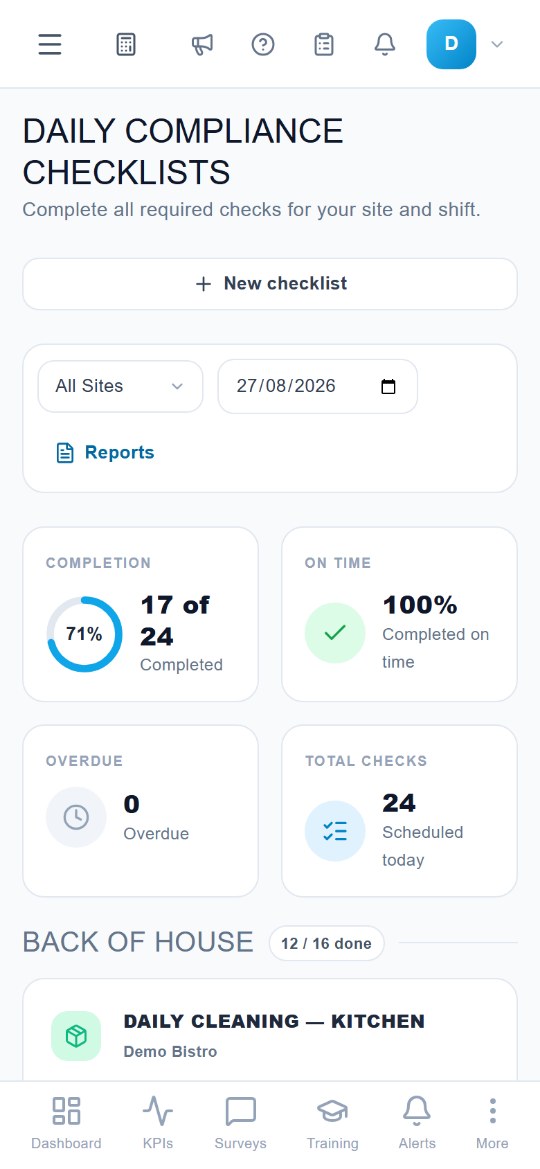
A calibration check can be recorded as a task on a daily checklist, with the result captured in a validated temperature field so it is timestamped and attributed to the person who carried it out. Where a reading falls outside the range set for it, a corrective action opens automatically and records what was done, the root cause and the prevention measure, moving through open, completed and verified rather than being ticked away. HACCP monitoring and corrective action software holds that alongside the plan it supports, and a daily job flags any corrective action still open after 24 hours.
Frequently asked questions
How often should a probe thermometer be calibrated in a commercial kitchen?
There is no single interval that applies to every business. The frequency is the operator's decision, set inside the HACCP-based food safety management system the business has to run, written down there and backed by the records showing each check happened. Add an extra check after a probe is dropped, left in a hot oven, moved between sites, or restarted on a new battery, since any of those can shift a reading.
What does the ice-point check involve?
Fill a jug with crushed ice, top it up with cold water, stir it, then hold the probe clear of the sides and base so it sits only in the ice and water mixture, and wait for the reading to stop moving. The manufacturer's instructions give 0 degrees Celsius as the reference point and state the variance the probe is expected to hold against it.
Do I need to check boiling point as well as ice point?
The ice point check is usually enough for chilled work such as fridge and delivery checks, because that is the range those tasks operate in. Where the same probe is used for cooking, hot holding or reheating, checking it against boiling water as well gives confidence at the temperatures those tasks actually run at, rather than only at the cold end of the scale.
What should happen when a probe fails its calibration check?
The probe should be taken out of use immediately rather than kept running until somebody remembers to deal with it. Record the failed reading, the date, and what was done about it, whether that is adjustment, replacement, or a temporary swap to a spare probe, so the corrective action is as visible in the record as the fault itself.
Does a battery change affect calibration?
A weakening battery is one of the more common causes of drifting or erratic probe readings, and it can happen gradually enough that nobody notices until a calibration check catches it. Logging battery changes alongside calibration results makes it easier to see when a run of odd readings has an obvious cause rather than pointing at the fridge.