Why managing online reviews needs a routine, not luck
General information for UK hospitality operators, not legal advice. If something here is wrong or out of date, the editorial policy explains how to report it.
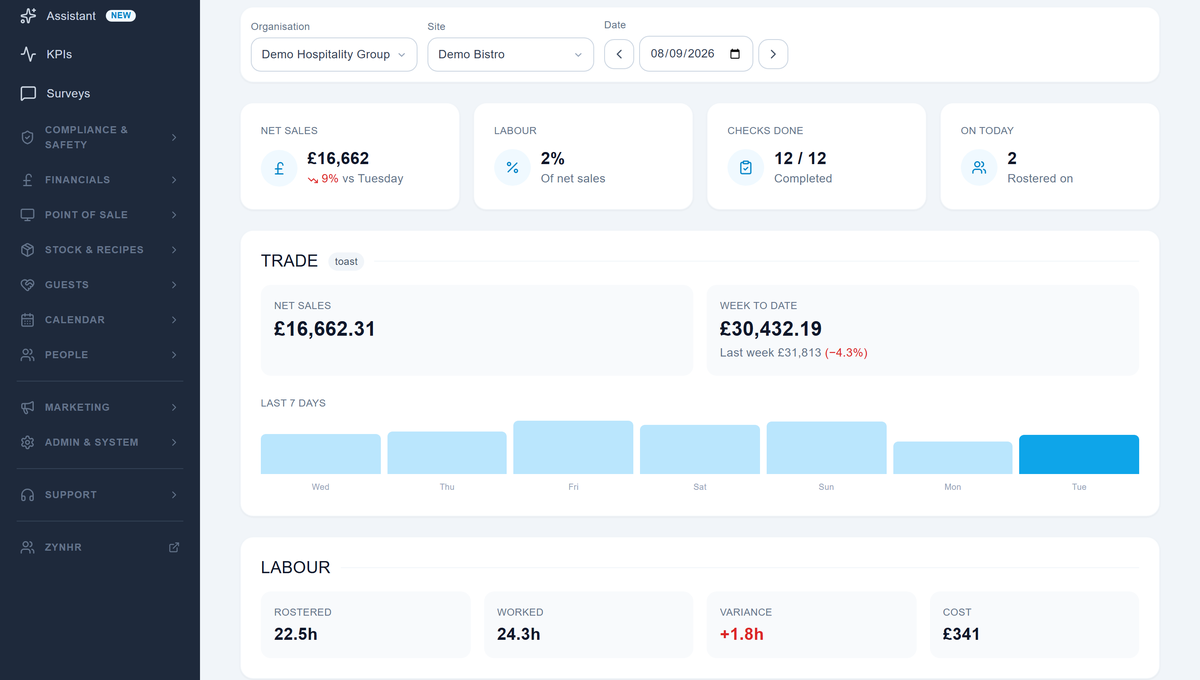
A routine beats luck: managing online reviews across several sites needs a named owner, a fixed cadence and one place to see every rating.
Managing online reviews works when one named person owns the job, the replies happen on a fixed schedule, and every site's ratings sit in one place rather than behind separate logins. Without those three things the work happens in bursts, a venue can slide for weeks before anyone notices, and the first sign of trouble is a guest mentioning it rather than a number somebody watches.
For a single site the gap between the rule and the reality stays small, because one manager can catch up within a day or two of a heavy week. For a group of four or five venues, each with its own Google Business Profile, its own TripAdvisor page and its own hygiene rating, the gap widens quietly, and nobody above site level can say which venue is drifting without opening a dozen browser tabs on a Monday.
What an unanswered review costs before anyone complains
A prospective guest reading a listing is buying information about an experience they have not had yet, and the pattern of replies is part of what they read. Five recent reviews describing the same cold plate, none of them answered, tells that reader the business either does not look or does not mind. Nothing on the page says the problem was fixed the following week, because nobody wrote it there.
Reputation behaves like any other operational measure in that respect. It drifts when nobody is deliberately holding it, it rarely drifts upward on its own, and the cheapest moment to act is when three complaints share a theme rather than when the average has already moved. Left as a marketing extra, it falls to whoever happens to see a notification, which on a busy Friday is nobody.
Why one site's slide stays invisible across a group
The numbers exist for every venue in a group. What is missing is a single view of them, because each platform keeps its own login and each site keeps its own listing, so any comparison has to be assembled by hand. A site with a falling average and a growing pile of unanswered replies therefore surfaces as a problem late, usually once footfall has already softened and somebody asks why.
One poor review rarely tells an operator much on its own. Three poor reviews at the same site within a fortnight, each naming slow service, tells them something worth acting on that week, and only a view across all the sites together makes the difference between the two visible. Reading each profile in isolation whenever somebody remembers is what turns an early signal into a quarterly surprise.
A response routine that survives a Friday
A workable routine needs a named owner and a fixed cadence, because without both the replies arrive whenever someone has a spare ten minutes. Site managers are usually best placed to write them, since they know which shift the complaint describes and can add a specific detail instead of a template line. Area managers should read ratings and response rates monthly, comparing venues against each other rather than judging each one on its own figures.
Speed matters, but it is worth setting a target the business can actually hit and writing that target down, rather than borrowing an hours figure from elsewhere and missing it every week. Tone matters at least as much. A defensive reply to a fair complaint does more damage than the complaint did, while an acknowledgement with a concrete offer to put things right reads well even to people who never visited.
Positive reviews are not only for morale
Thanking a guest for a good review takes a minute and reinforces what earned it, and it also shows anyone browsing the listing that the business engages when there is nothing to manage. A profile with varied, recent replies reads as actively run, which carries weight alongside the stars themselves.
When a review is really a compliance signal
Some reviews are not service feedback at all. A guest describing a dirty table in the middle of a quiet afternoon, an allergen question the team could not answer, or a slip near the bar is describing something the venue should be able to find in its own records, and the useful question is whether a matching entry exists. Where it does not, the gap is in how incidents get logged rather than in how reviews get answered.
The hygiene rating sits in the same public picture as the stars, and the display rules differ by nation. In Wales and Northern Ireland a business is legally required to display its rating at or near each customer entrance, while the Food Standards Agency guidance on displaying your food hygiene rating tells businesses in England that they can display it in the window or door. That scheme covers England, Wales and Northern Ireland; Scotland runs its own Food Hygiene Information Scheme. A group operating on both sides of a border needs to know which rule applies where.
What the law now says about fake and incentivised reviews
Since 6 April 2025, submitting a fake consumer review, commissioning another person to write one, or posting a review that conceals the fact it was incentivised has been a banned commercial practice under Schedule 20 to the Digital Markets, Competition and Consumers Act 2024. The same paragraph covers publishing consumer reviews, or information about them, in a misleading way, and it applies across the United Kingdom.
In practice that rules out asking the team to post five stars from personal accounts, and it rules out offering a free round in return for a review unless the review says so. Asking only the guests who looked pleased is a habit worth dropping too, partly because it distorts the picture the business is trying to manage, and partly because the line between selective collection and misleading publication is not one to test. The Competition and Markets Authority publishes guidance on fake reviews for businesses that collect or publish them, which is where to check a specific practice before adopting it.
Staff often see the cause of a run of complaints before a guest writes one, whether that is a rota gap on a particular shift or a training point nobody has closed. A structured staff feedback channel is the cheaper route to the same information, because a problem fixed internally never reaches a public page.
Managing online reviews alongside labour, waste and sales
Review scores read better next to the rest of the operational data than they do alone. A rating that slides three weeks after labour was cut at one site is telling an operator something neither number says by itself, and a falling average alongside rising waste points at the kitchen rather than at one unlucky evening. Operators who already track sales, labour and stock through a multi-site management routine are better placed to spot that coincidence while it is still cheap to act on.
Zynthio treats reputation as an operational number for the same reason. It appears on the KPI dashboard as one of four dials, next to clock-in accuracy, labour budget against revenue and salary utilisation, banded good at 80 per cent, and putting it beside labour is deliberate. Pulling the ratings into the same review management dashboard as the rest of the estate's numbers is what moves reviews from an occasional glance at Google to something checked on a schedule.
Doing this without the paperwork
Checking several platforms across several sites, one login at a time, is the task that slips first when service gets busy. The Zynthio review management module pulls Google, TripAdvisor and the FSA hygiene rating into one dashboard per site and rolled up across the group, matching each rating to a site by name and postcode, with a reputation score out of 1000 built from the rating, the volume behind it and how recent the reviews are.
Two limits are worth knowing before relying on it. There are no alerts for a new review, so a one-star at two in the morning waits until somebody opens the page, and Google returns at most five reviews per location, which makes the individual list a rolling sample rather than a full history. A reply drafted in Zynthio is saved as the venue's own record, with a copy button, and it is never posted publicly from inside the system.
Frequently asked questions
How quickly should a restaurant respond to a negative review?
As promptly as the business can realistically manage, against a target it has written down rather than one borrowed from elsewhere. A reply that lands while the complaint is still current reads as attention; one that lands a fortnight later reads as housekeeping. The more useful discipline is that a named person owns the replies and that the same target applies at every site in the group.
Should every review get a reply, including five-star ones?
Not every single one at a high-volume site, but a consistent share should. Thanking positive reviewers costs a minute and shows a browsing guest that the business engages when there is nothing to defend. Every negative or mixed review warrants a considered reply, because those are the ones a prospective customer reads most closely before deciding whether to book a table.
Who should own review management across multiple sites?
Usually the site manager handles day-to-day replies, because they know which shift a complaint describes, with an area or operations manager reading ratings and response rates monthly across the estate. Without a named owner at each level, replies happen inconsistently and a drifting site gets noticed late. Write the owner and the cadence into the same routine as stock counts and rotas.
Can a bad review be removed from Google or TripAdvisor?
Each platform applies its own content policies and makes its own removal decisions, so genuine criticism of food or service will normally stand whether or not the operator agrees with it. Reviews that are fake, or that hide an incentive, are a different matter: those are a banned practice under the Digital Markets, Competition and Consumers Act 2024, and each platform has a reporting route for them.
Is it legal to offer guests something in return for a review?
An incentive is not automatically unlawful, but a review that conceals the fact it was incentivised is a banned commercial practice under Schedule 20 to the Digital Markets, Competition and Consumers Act 2024, as is commissioning a fake review. If anything is offered, the review has to disclose it. The safer habit is to offer the review link to every guest rather than only the pleased ones.