Fair tips: what the Allocation of Tips Act requires now
General information for UK hospitality operators, not legal advice. If something here is wrong or out of date, the editorial policy explains how to report it.
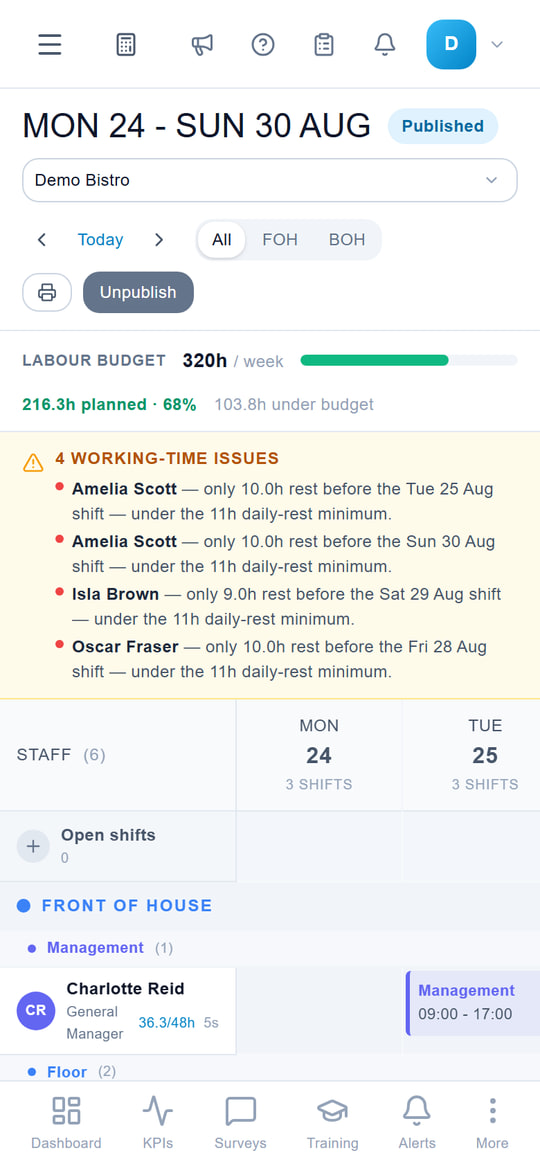
The allocation of tips act requires all tips to reach staff in full, fairly and on time. What employers in England, Wales and Scotland must have in place.
The Allocation of Tips Act requires employers to pass on all tips, gratuities and service charges to workers without deductions, to allocate them fairly, and to pay them no later than the end of the month following the month in which the customer paid. Those duties sit in the Employment (Allocation of Tips) Act 2023, which extends to England and Wales and Scotland, so employers in Northern Ireland are not covered by this particular Act. For venues in the three nations it does reach, the practical question is no longer whether tips get to staff, but whether the method used to split them can be explained, evidenced and defended the first time a worker asks.
What the Allocation of Tips Act requires
Four duties apply together rather than as options to pick from. The first is payment in full. The statutory code of practice on distributing tips fairly, which came into force on 1 October 2024, records that the Act makes it mandatory for all tips to be passed on to workers without deductions. Deductions are limited to those a statutory provision requires or authorises, which is why the cost of card processing, a breakage or a till shortfall cannot be taken out of the pool before it is shared. The second duty is fair allocation, and in deciding what is fair an employer must have regard to the relevant provisions of that code, which is also the document an employment tribunal has a duty to take into account when a worker brings a claim. The third is a written tipping policy for the place of business, and the fourth is a record of how every tip was dealt with. Running underneath all four is a hard deadline: section 4 of the Act requires both the allocation and the payment to happen no later than the end of the month following the month in which the tip, gratuity or service charge was paid by the customer, so money left on a table in January has to reach the worker by the end of February.
Who and what the rules cover
The duties bite on qualifying tips, which means tips the employer receives, and tips a worker receives where the employer exercises control or significant influence over how they are dealt with. Cash a customer hands straight to a member of staff who keeps it, with no involvement from the business, falls outside that definition. Card tips, app tips and voluntary service charges that land in the business bank account are squarely inside it, and so are tips attributable to a place of business even where the money was taken centrally. Scope also runs past the payroll. Under the agency worker provisions of the Employment (Allocation of Tips) Act 2023, an eligible agency worker doing work at a place of business is treated as a worker of that business, and the business is treated as the employer for these purposes. The amount owed can be paid to the agency rather than direct to the worker, but the agency must then pass it on before the end of the month after the month it received the money, and neither the venue nor the agency may make a deduction that no statutory provision requires or authorises. A tronc that quietly covers permanent staff only, while agency cover works the same sections on the same nights, is a scheme with a hole in it.
Building a tronc allocation that holds up
A tronc is the arrangement for pooling and sharing tips across a team, and the schemes that last share on a method that can be explained in one sentence and applied the same way every week. Points weighted by role and by hours actually worked stand up better than points based on hours rostered, because a shift that ends early or runs two hours long changes what somebody is owed on the night. A kitchen porter and a head chef are unlikely to sit on the same point value, and a system that pretends otherwise will not convince either end of the team. Consistency matters more than the elegance of the formula: the same rules applied to the same data, week after week, so nobody can argue the outcome depended on who was asking or on who happened to be doing the sums that day. Where a business changes its method, whether to add a role band or to adjust weighting after a service review, the change should be written down and explained before it takes effect rather than discovered in a smaller than expected payout. Fairness is judged on the allocation, not on the good intentions behind it, and a method nobody can describe is difficult to defend as fair.
The written policy and the three-year record
A policy that exists only in a manager's head is not a policy for the purposes of the Act. Section 6 requires a written policy wherever tips are paid at a place of business on more than an occasional and exceptional basis. It has to say whether the business requires or encourages customers to tip, and how tips are dealt with and allocated between workers at that site, and it has to be made available to every worker there, including each later amended version. The same section carries the records duty. The employer must create a record of how every qualifying tip was dealt with and keep it for three years beginning with the date the tip was paid, showing the amount received at that place of business and the amount allocated to workers, whether allocated by the employer or arranged through an independent tronc operator. A worker can ask in writing for the figures covering a month, or several consecutive months, beginning no more than three years before the request, and may make one such request in any three-month period. The employer then has four weeks to provide them. Four weeks is not long enough to rebuild a year of allocations from memory, which is the practical argument for writing the record as the tips are shared rather than when the request arrives.
Why tronc gets complicated on a real rota
The theory is tidy and the shift rarely is. Front of house tends to argue for a split weighted toward service, while the kitchen points out that the food is half the reason a customer tipped at all, and both arguments deserve a hearing before a formula is fixed rather than after the first payout. Card tips and cash tips arrive by different routes and often get handled inconsistently as a result, with card going through a formal process while cash is shared out on the night by whoever happens to be on. Staff who work across two sites, or who pick up occasional cover, complicate any allocation built around one fixed rota, because their hours at each place of business have to be tracked separately while the allocation at each site still has to be fair on its own terms. Late changes make it worse: a shift swapped on the Friday, a clock-out somebody forgot, a section covered by an agency worker at short notice. Built on a spreadsheet filled in after the fact, from memory or from a rota that moved twice before service, the numbers are hard to defend the moment somebody asks a direct question about their own share.
Where tronc meets the rest of pay compliance
Tronc rarely sits apart from the rest of pay administration. Getting the underlying hours right matters here for the same reason it matters for National Minimum Wage compliance, since both depend on a record of when somebody actually worked rather than on what the rota said they would. The same discipline shows up in cost control: a business with a firm grip on controlling labour costs without cutting service is usually the business that can produce a clean tronc record without a scramble at month end. Rotas, attendance and tip allocation are three views of the same underlying data, and treating them as separate exercises is where the errors start, whether that is a share calculated from a rota nobody updated or a payment that slips past the statutory deadline because the hours were never reconciled in time. Rota and attendance software that also handles the tip pool closes the gap between the hours the rota planned and the hours the tronc actually pays on, which is the gap most disputes live in.
Next step
See how Zynthio's rota software distributes tronc by points per position against attendance recorded through geofenced clock-in and approved timesheets.
Frequently asked questions
Does the allocation of tips act cover cash tips as well as card tips?
It covers tips the employer receives, and tips a worker receives where the employer controls or significantly influences how they are dealt with. Card payments, app tips and voluntary service charges taken by the business are therefore in scope. Cash a customer hands directly to a worker who keeps it, with no involvement from the business, sits outside the Act.
How quickly must tips be paid to staff?
No later than the end of the month following the month in which the customer paid the tip, so a tip left in January must reach the worker by the end of February. Section 4 of the Act sets the deadline for both the allocation and the payment, so a slow tronc calculation or an unresolved argument about the split is not a reason to hold the money back.
Does the Act apply in Northern Ireland?
No. The Employment (Allocation of Tips) Act 2023 extends to England and Wales and Scotland, so it does not place these duties on employers in Northern Ireland. Operators running sites on both sides of the Irish Sea should treat the Northern Ireland position separately rather than assuming one tipping policy covers the whole group.
Are agency workers entitled to a share of tips?
Yes. An eligible agency worker doing work at a place of business is treated as a worker of that business for these purposes, so leaving agency cover out of the tip pool is a breach. The amount can be paid to the agency instead of the worker, but the agency must pass it on before the end of the month after the month it received it, without unauthorised deductions.
What counts as a fair allocation method?
There is no single mandated formula. The employer must have regard to the statutory code of practice in deciding what is fair, and in practice that means a clear, justifiable basis applied consistently, such as points weighted by role and by hours actually worked. What is difficult to defend is an allocation that moves with manager discretion and leaves no recorded basis.