Till reconciliation: where the cash actually goes missing
General information for UK hospitality operators, not legal advice. If something here is wrong or out of date, the editorial policy explains how to report it.
Till reconciliation is the daily check that turns a vague cash shortfall into a specific, traceable problem a manager can actually investigate and fix.
Where does till cash actually go missing in a pub or restaurant? It goes missing in small amounts, repeated often, in the gap between what the till expected and what the drawer holds at the end of a shift, and till reconciliation is the daily routine built to close that gap before it becomes a pattern nobody can explain.
How till reconciliation actually works
Till reconciliation is the process of comparing what a till system expected to have in the drawer, based on recorded sales and any recorded cash movements, against what is physically counted at the end of a shift or a trading day. Done properly it is not a single number produced at close of play. It is a chain of steps: a known float counted at the start of a shift, a record of any cash taken out or put in during service, a blind count of the drawer at the end, and a comparison against the till read that produces either a match or a documented variance with a name attached to it. Skip any link in that chain and the figure you end up with tells you almost nothing useful about what actually happened during the shift, because a clean total at the end can still hide a shortfall in one drawer offset by a surplus in another. Across a multi-site business, the same weakness multiplies: a small unexplained gap that looks trivial at one venue becomes a pattern worth investigating once it is visible across several sites in the same week.
Card has taken over most hospitality transactions, but cash has not disappeared from the parts of the business most exposed to loss: floats, tips paid out of the drawer, petty cash handed to a window cleaner or a supplier collecting on the day, and refunds processed without a manager present to authorise them. Even in a mostly cashless venue the same reconciliation discipline applies to voids, no-sales, discounts and cancelled orders logged through the EPOS, which is one reason EPOS data reviewed daily catches problems that a monthly glance at the accounts never will.
The float and the handover
A float should be a fixed, known amount, counted by both people present at a handover and signed for by each of them before service starts. This sounds like a formality until the first discrepancy appears, at which point the handover record becomes the only evidence of who was accountable for that drawer at that time of day. Where a till allows individual operator logins, assign one person per drawer for the length of their shift so any variance has one name attached to it rather than a whole team. Where several staff share a single drawer across a busy session because the till only supports one login, any variance at the end becomes impossible to attribute fairly to a person, and everyone working that shift is aware of it, which quietly removes any individual incentive to be careful with cash.
Count blind, compare second
The single most useful change most venues can make costs nothing and needs no new equipment: count the drawer and record the total before looking at what the till expects to see. If the person cashing up sees the expected figure first, small discrepancies have a habit of vanishing, either through a count that drifts towards the answer that is already known, or through a note quietly moved from one drawer to another to make two totals balance. Counting first and comparing second turns the cash-up from a box-ticking exercise into an actual measurement, and it is the single control that most reliably separates venues with genuinely tight cash discipline from those that only believe they have it because nobody has ever tested the assumption. Where a manager cashes up several tills in one sitting, blind counting each one separately, before any comparison, also stops a shortfall on one till being quietly covered by a surplus on another, which is a common way a real problem stays invisible for months.
A threshold you enforce
Decide what counts as an acceptable variance and write it down rather than leaving it to a manager's mood on the night. As an illustration only, since there is no trade-body figure to point to, a venue might set a small fixed amount, such as a few pounds, or a percentage of that shift's cash takings, whichever is lower, and require a signed note above that line before the cash-up can be closed off and banked. The figure itself matters less than the consistency of applying it. Say a £4 variance is waved through on a quiet Tuesday but questioned on a busy Saturday: that inconsistency amounts to having no threshold at all, and staff notice quickly, which undermines the whole exercise. Investigate overs with the same seriousness as unders. A drawer that regularly comes in high is not free money sitting in the till; it usually means a sale has been rung in incorrectly, a discount was not applied as it should have been, or someone is quietly building a small surplus to draw on later without it ever showing as a shortfall on the day it is taken.
Patterns worth watching
Watch for voids, no-sales and refunds that concentrate on one operator or one particular shift rather than spreading evenly across the whole team over a month. Watch for discounts applied late in the evening, after a manager has already left the floor, and for items cancelled after payment has already been taken, which can be a way of extracting cash without it ever appearing as a shortfall on that day's count. Variances that cluster on the same day of the week, or the same shift pattern, point to a specific rota gap rather than a general weakness across the whole operation, and are worth cross-checking against who was actually working that shift. None of these patterns proves dishonesty on their own, but each one is a reason to look closer before it becomes an established habit rather than an isolated incident, and each is far easier to spot with a run of daily records than with an occasional spot check carried out once a quarter. Where a pattern does point to one individual, it is worth revisiting how that person was trained on refunds and discounts before assuming deliberate intent, since a gap in training produces the same numbers on a report as dishonesty does.
Separating duties, keeping paperwork
The person who counts the drawer should not be the same person who prepares the banking, and the banking itself should carry a second signature before it leaves the building. Safe drops during a busy shift limit how much cash sits in any one drawer at any one time, and counting itself should happen away from the till point rather than in view of customers or other staff, particularly where a member of staff is cashing up alone after close, when a phone call or text check-in with a second manager before the money leaves the building is a reasonable safeguard. This is not about suspecting a particular individual; it protects honest staff from being the obvious suspect the next time a discrepancy appears with no clear explanation attached to it. Keep the paperwork that supports all of this. Till reads and cash-up sheets reconcile the tills to the bank and support the VAT records that a business is required to retain for six years, a duty that sits with the business rather than with any till or cash-up software it uses. If a variance ever ends up as a disciplinary matter, a documented history of counts and notes is what a fair disciplinary process will ask to see first; employers in Great Britain follow the Acas Code of Practice on disciplinary procedures, while employers in Northern Ireland should refer to the Labour Relations Agency's equivalent code instead. The same counting discipline that underpins accurate weekly stock counts applies just as directly to cash, because both rely on someone counting honestly before they know what the answer is supposed to be. Building this routine into a proper cash management process rather than a loose habit is what turns till reconciliation from an occasional worry into something that catches problems within days rather than months, and it is worth treating with the same seriousness as any other daily compliance record kept in the business.
Where Zynthio fits
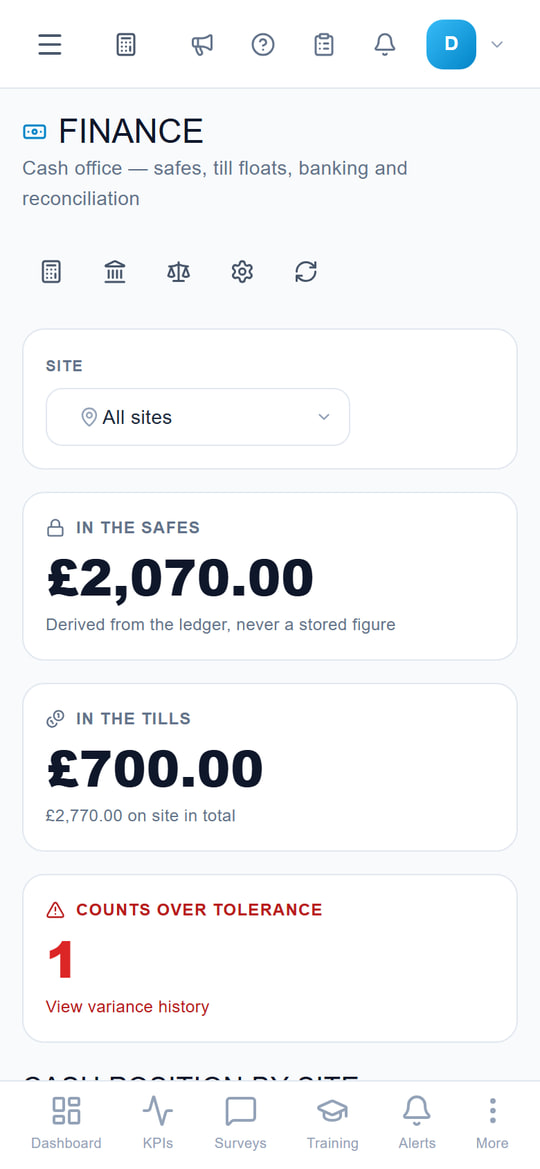
Zynthio's cash management software keeps counts and till figures on an append-only ledger, so a saved entry cannot be edited or deleted, only corrected by a further written adjustment. Counts are entered by hand against a five pound tolerance by default, tightened to zero on banking, and nobody can witness their own count, which keeps the responsibility for each drawer split between at least two people.
Frequently asked questions
How much cash variance should trigger an investigation?
There is no legal figure, so venues set their own. A common approach is a small fixed amount, such as a few pounds, or a percentage of cash takings for that shift, whichever is lower. What matters is applying the same threshold every time and requiring a written note whenever it is crossed, rather than only asking questions when a variance is large.
Should overs be investigated as well as unders?
Yes. A till that is consistently over is not a harmless surplus. It usually points to a service being rung in incorrectly, a discount not applied properly, or someone building a small cushion in the drawer that they draw down from later. Treat overs with the same written explanation you require for shortfalls.
Who should count the till at the end of a shift?
Ideally not the same person who has been solely responsible for that drawer all shift, and not the person who then banks the cash without a second signature. Splitting counting, recording and banking across at least two people protects honest staff from suspicion as much as it catches deliberate theft.
How long do we need to keep cash-up and till read records?
Cash-up sheets and till reads support your VAT records, which a business is required to keep for six years. In practice, keeping digital records with a timestamp and the name of the person who completed the count makes this straightforward to satisfy and to produce if HMRC or an auditor asks for it.
Does card-only trade remove the need for till reconciliation?
No. Reconciliation also covers voids, no-sales, refunds, discounts and cancelled items processed through the EPOS, all of which happen regardless of payment method. A venue that has gone mostly cashless still needs to review these patterns daily, because they are often where losses concentrate once cash itself is scarce.